

Beauty from Pain
Austin Tunnell turns a painful life into beautiful buildings, and gets a chance to build the city of his dreams.
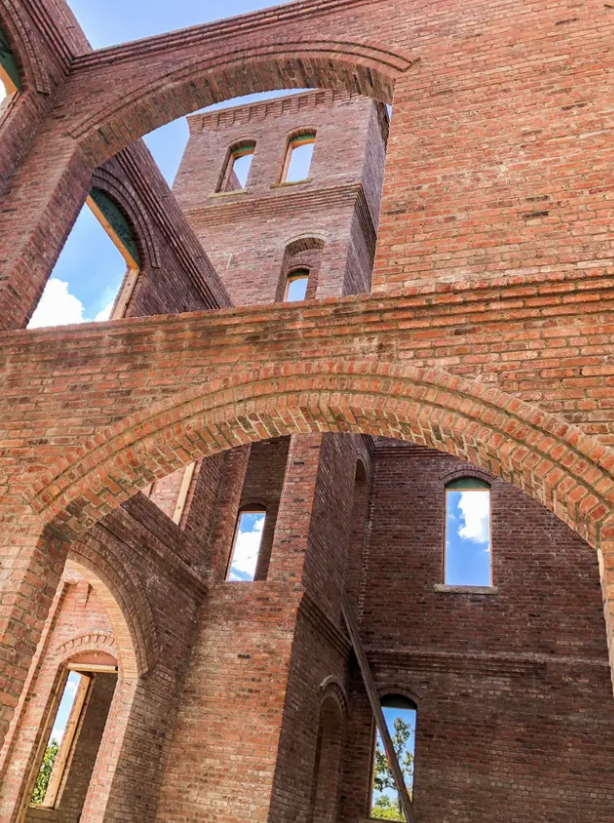
When Austin Tunnell announced that he’d broken ground late last year on Townsend, a “pocket neighborhood” he developed to fill an acre of space in Edmond, a town on the northern edge of Oklahoma City, he framed it as the start of a new chapter for everyone involved in the project.
A cohesive development that will, after a few years of phased construction, encompass 18 townhouses, two live-work buildings, and a large suite of commercial spaces, all oriented around a central courtyard, it’s an ambitious jump scale for his firm, Building Culture. But more importantly, Tunnell explains, it’s a proof of concept for his vision for inward-facing, walkable, holistic neighborhoods. Built using loadbearing, hand-laid brick, the homes and shops in his ideal neighborhood should have a unified, warm, and human visual identity – and will certainly be incredibly durable. If all goes to plan, Tunnell hopes, Townsend will not only empower his company to build more pocket neighborhoods in the Oklahoma City area in the near future, but inspire other developers to follow his simple yet elegant vision for neighborhood design as well.
Yet while Townsend could be the start of something new, it’s also the end of another chapter in Tunnell’s life. Of his difficult journey from a nebulous discontent with the way things are to a clear vision of what they could be. Of a gradual shift from ideological purity towards a practiced pragmatism. And of his progression from a sketchbook dreamer to a full-fledged developer.
--
Tunnell’s story started with misery.
Lacking clear goals in college, he’d defaulted into his father’s footsteps, pursuing a career as a Certified Public Accountant. Right out of school, he secured a gig with KPMG, one of the “Big Four” accounting firms – a ground-floor yet prestigious position. He had friends, hobbies, and a level of stability most Americans can only dream of. But a year into his first career, Tunnell realized he was depressed. So depressed that he couldn't get off of his couch on the weekends, and felt a panic attack coming on whenever he thought about the start of the work week.
At first, he wasn’t sure what was wrong with him. Sure, he worked almost 80-hour weeks like most entry-level peons in high-income fields. But hard work didn’t bother him. HeNo, gradually realized, the issue wasn’t the hours. It was the fact that he didn’t care about the work eating up so much of his life. Happiness comes from the pursuit of passion and purpose, he figured. So he ought to figure out what really motivated him and build a career around pursuing that.
After a few weeks spent searching for “cool jobs” and “interesting jobs,” Tunnell quit his actual job, sold his car, and left the country towards the end of 2012 with only $20,000 to his name. He’d secured a half-year internship at Kalu Yala, a then-buzzy (but ultimately ill-fated) off-grid and sustainable village under development in interior Panama – and a stopgap on his journey towards a Peace Corps post in rural Uganda. That stint in the jungle, spent with out-of-the-box thinkers, introduced Tunnell to new urbanism, a theory of development focused on walkable, mixed-use neighborhoods. Which got him thinking about his childhood in the Houston suburbs, as well as his experiences backpacking in Europe for a few months after college.
He’d loved biking around developments and exploring nearby forested areas with his friends while growing up. But he already knew that urban sprawl tends to replace that suburban ideal with an isolating prison – a neighborhood where you need a car and a commute to do anything. And that realization made him envy the Europeans and their durable, beautiful buildings and their walkable neighborhoods. Kalu Yala helped him envision how someone could bridge the gap between those realities by building something new and intentional – and it led him to the study of architecture and design during his ample downtime in Uganda. He thought about reading up on other passions, yet he kept coming back to this one. So in late 2014, towards the end of his Peace Corps service, he figured he’d go back to college for urban design or some related field.
But after two years spent in the bush, growing disillusioned with international development, academia, and traditional pathways in general, in 2015 Tunnell found himself by 2015 at another crisis point. Rather than go straight back to school as he’d planned, he returned to Kaula Yala for a few months to regroup, and seriously considered jumping ship on his idealistic journey for a job at Facebook (now Meta). Then he called Clay Chapman, a stone mason he’d met in Panama who was trying to bringweave structural masonry – the type of load-bearing, full-brick construction Tunnell fell in love with while traveling in Europe – into modern construction. Chapman’s vision for revitalizing this technique, which fell out of favor with the advent of mass-produced timber, concrete, and steel, spoke to Tunnell’s nascent desire to help design and build a more beautiful and thoughtful world. So he asked if the craftsman would take him on as an apprentice.
After successfully moving through several steps in the process, the Facebook job Tunnell was up for evaporated. But Chapman agreed to let him join his team in Oklahoma to learn from them for maybe a week.
With a little begging, that week became a two-year apprenticeship.
These were rough years. Tunnell, newly married to a fellow Peace Corps volunteer he’d fallen for in Uganda, was living on a $12 per hour salary in a sketchy neighborhood, doing hard labor, all while coping with the after effects of diseases he’d picked up abroad. (Dengue, malaria, schistosomiasis, and several fungal and parasitic conditions.) Still, the work infused Tunnell with a sharper sense of mission. With a belief that society has, in the pursuit of low-cost efficiency, lost ancient skills, like brick masonry building, which often result in more compelling and lasting structures. And with a dedication to helping Chapman revive and modernize that art.
Yet Tunnell quickly realized that he’s not a craftsman like Chapman. He liked being outside and working with his hands. But he didn’t relish the idea of spending his life perfecting the fine art of laying a line of bricks. His mindset was, on a fundamental level, more entrepreneurial. He wanted to turn the craft into a venture. So he spent his free time playing around with DIY designs for full-masonry structures. They were simple but elegant visions, based on his tastes and what he knew he could build. “I thought I’d figure out how to scale masonry building,” he tells GPLetters – that he could create a more prolific business around Chapman’s builder ideals.
Then in 2016, he moved from his low-rent neighborhood to a garage apartment in a better part of town. (His homeowner-landlord offered him a rent deal in exchange for doing a little yard work.) One day, thesaid landlord took an interest in Austin’shis sketches and struck up a conversation, which turned into a deal: He’d hook Tunnell up with another novice builder, and back them in an effort to build a new community in the lakefront resort town of Carlton Landing – a set of six houses curved around a green space, three built to Tunnell’s masonry ideal, now known as The Bend. Tunnell jumped aton the deal, built his simple stone homes, and found rapid success: He pre-sold the units for cash, wrapped construction in 2019, and earned a design award in 2020.
That success was invigorating. It convinced Tunnell some of the ideas he’d been incubating were right: Modern construction practices really weren't the best or only approaches, just a slowly accreted consensus. His inexperience was a gift. It led him to intuitive truths that challenged these sclerotic norms. And people were willing to pay for the warmth and durability of a brick home in a walkable area, even if the design was simplistic. They’d pay for his homes. Maybe he could turn his passion into a career as a specialized builder, spreading the gospel of structural masonry. Maybe he’d assist in other projects to spread the good word. Maybe he’d train a team of brick evangelists. His future as a mission- and craft-driven entrepreneur seemed bright.
Then life kicked him in the teeth.
--
In the spring of 2020, with his first child on the way, Tunnell decided to devote himself to Building Culture, the venture he’d incorporated to build his share of the homes in The Bend. Then COVID hit, markets crashed nationwide, and the little resort community he’d started out in went from a booming lakeside hub to a ghost town as people sold off their properties.
Tunnell was already prepared to move out of Carleton Landing and build homes further afield. But when he called his brick supplier, they told him that their supply chains were disrupted, so he’d have to figure out some new solution to build his next few houses he’d planned to build.
These harsh realities forced the idealistic young Tunnell to confront the exigencies of development – notably the idea that supply, demand, and profit margins wouldn’t always align with his masonry-purist vision for homebuilding. So from 2020 to 2021, he made compromises, taking gigs as a brick builder for local clients, which he refers to now as “survival projects” – builds where he got to do some cool masonry, but couldn’t control the design or sense of place.
Then he got hit by a city bus, which ran a red light at nearly 40 miles per hour right into his car.
The accident left Tunnell with a mangled foot, which has required several rounds of surgery since the incident just to keep him functionally mobile. (He’s still recovering today, and can’t walk too far without a rest or the aid of a cane.) It shattered something more fundamental, as well: Tunnell’s belief that life is a story – a narrative in which he, a protagonist, would find his one true identity and passion, stick with it, and everything would work out for him once he did.
“When I look back at 2021 through 2023,” he admitted to GPLetters, “I can’t actually remember much.” He was running on fumes. Forget all those ideals about bringing traditional brick work into the modern era. All he could do was stay afloat. Bankruptcy loomed over the horizon.
Even before the pandemic, Tunnell told GPLetters, he’d slowly started to acknowledge that the full structural masonry builds he’d fallen in love with don’t always work. Brick buildings speak to his soul. Yet that masonry is so niche as a skill and building material that it’s functionally a boutique service rather than an accessible resource. He’d recognized that he might need to embrace occasional concessions to modern building materials and conventions, like lumber framingframes, to make his plans work if he wanted to serve more than just resort town consumers.
But now he had to step back to evaluate what he really cared about. It wasn’t craftsmanship alone, he decided. Or really, it couldn’t be, because he physically couldn’t spend his days onsite anymore. No, he had to dig down to the root drive that drew him towards Chapman’s masonry, what he really wanted to accomplish withby a real estate venture, and what his identity should be.
“It’s really about transforming the built environment into a thriving human habit,” he decided. And thus his goal was to develop entire communities that exemplify that holistic vision.
Structural masonry is a part of that vision, he affirmed, because it truly is durable, practical, and beautiful in many contexts. But he now makes concessions to concrete, steel, and lumber wherever he needsed to do so for practicality, keeping his primary focus on top-level walkability and unified visual identity. In a sense, he tells GPLetters, his vision flipped from “wanting to grow a 50-person general contractor company” to do everything in stone, to creating a company around a vision they can contract out rather than “GCing every one of our projects.”
“Ultimately, my vision is to prove a model,” he explains. “Then to raise a fund, partner with other developers – small developers across the country,” and help them work on walkable neighborhoods built around something like a courtyard and a core of structural masonry as well.
--
Early on, Tunnell wasn’t sure why people gave him a chance to build homes. Before developing The Bend, he acknowledges, he was a pure novice. And afterwards, he freely admits, he was still a neophyte, pivoting wildly to stay afloat. At first, he thought that brick buildings itself was the draw: People wanted the technique, and he was one of the only craftsmen meeting their latent needs. But as he opened up in blogs, podcasts, and social media posts over the last few years about the roadblocks he’s faced and pivots he’s had to make, he’s realized that it’s not just the methods and materials that draw people in. It’s his authentic passion, candor, and dedication.
He’s thankful to all of the friends and colleagues who helped him stay afloat while he struggled to literally get back on his feet in the early 2020s, and reconfigure his vision from one of pure masonry to a broader focus on holistic neighborhood-level development. And he’s especially thankful to one investor he met in 2020, who not only stuck by him through less inspired projects and personal travails, but in 2023 introduced him to the town of Edmond and the future Townsend site. (This individual also stuck with him when he decided to shift Townsend from a project Building Culture planned to exit after five years, to one the company would keep a stake in long-term – a shift he admits led to “hard conversations” with a few other backers.)
To Tunnell’s mind, the Townsend project is the final step in his evolution from a craftsperson to a builder to a developer, focused on big picture plans. The endeavor certainly has forced him to spend less time focused on the nuts-and-bolts of design and construction, and more time on raising money. Whereas his previous projects relied on one or two backers who left him to concentrate on the builds themselves, Townsend is large – a $33 million project at least – and its viability hinged on securing a mixture of local tax incentives and private investors. (Through a blend of social media and personal network outreach, Tunnell has brought in over 30 investors.)
The project’s only in its first phase, and Tunnell is still struggling to step away from nitty-gritty oversight. Especially now that they’ve started work on the structural masonry bones of their first structures, he says, he can’t help but spend more time than planned troubleshooting problems when he’s onsite. But he’s already starting to look towards future projects. “We’ve got land,” he says. “Another about 1.1 acres. Unlike Townsend, which is fairly high-end, we’re going to do market-rate townhomes. We’re hoping to get a third walkable project in the works soon.”
And he’s started thinking about how to codify his vision, after iterating so many times to reach it. “I don’t want to over-formalize things like a corporate culture,” he says. “At the same time, we need real processes if we want quality control to stay in place – even if I take a step back.”